
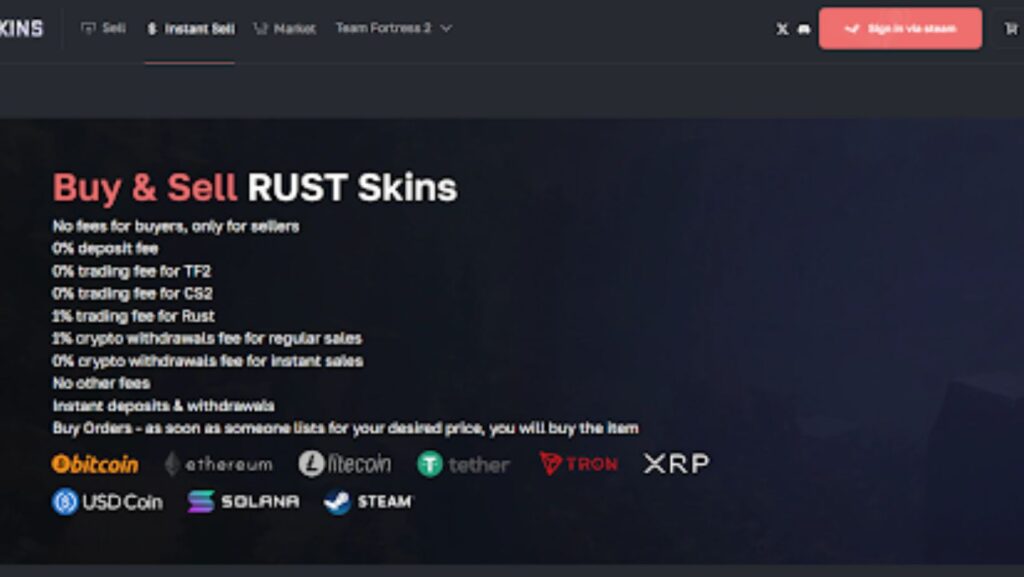
By 2026, selling Rust skins has become a structured market rather than a side activity. Skins are no longer just cosmetic items; for many players they’re digital assets with real resale value. Since the official Rust store doesn’t allow reselling, anyone who wants to turn skins into balance or real money has to use third-party platforms.
These platforms differ a lot in how they handle listings, pricing, payouts, and risk. Some prioritize speed, some prioritize price control, and others focus on minimizing fees. Choosing the wrong one can mean selling too cheap, waiting too long, or losing a noticeable chunk of your profit to hidden costs. Choosing the right one means aligning the platform with your actual goal: fast liquidation, maximum return, or long-term trading.
This guide breaks down the main types of selling platforms in 2026, explains how to choose between them when you want to know where to purchase RUST skins, and shows what you should always check before you list your first item.
The Right Platforms To Sell Rust Skins In 2026
By 2026, the Rust skin resale market has settled into three dominant models: Rust-focused marketplaces, large multi-game platforms, and peer-to-peer (P2P) marketplaces with escrow. Each of these models creates a very different selling environment. They influence who sees your listings, how quickly items move, how prices are formed, and how much control you have over the final outcome of a sale.
Choosing between them isn’t about finding a single “best” option. It’s about matching the platform’s structure to your goal. If you want fast turnover, you’ll make different choices than someone trying to maximize the price of a rare or collectible item.
How These Sites Compare In Fees, Payout Speed, And Buyer Traffic
Although every platform has its own rules and interface, the biggest practical differences for sellers come down to three factors:
- Fees: How much the platform takes from each sale, and in what form (seller fee, transaction fee, withdrawal fee, etc.).
- Payout speed: How quickly you can turn a completed sale into usable money.
- Buyer traffic: How many potential buyers see your listing and how motivated they are to buy.
Each of the three main marketplace models optimizes these factors in a different way.
Rust-Focused Marketplaces
Rust-focused platforms are built entirely around one game and one economy. That focus has a big impact on both buyer behavior and seller results. When someone visits a Rust-only marketplace, they are not casually browsing across multiple games—they are there with a specific intent: to buy Rust skins. This creates higher-quality traffic, meaning a larger share of visitors are potential buyers rather than passive window-shoppers.
For sellers, this environment is usually the most balanced in terms of risk and reward.
Why targeted traffic matters
Because the audience is already interested in Rust items, your listings are:
- Shown to buyers who understand the game and its cosmetics
- More likely to be evaluated on their actual value rather than impulse pricing
- Less likely to get lost among unrelated items from other games
This improves conversion rates, especially for skins that are not ultra-mainstream but still have clear appeal to Rust players.
Pricing behavior and market stability
Rust-focused platforms tend to have more stable pricing. Most participants are familiar with typical price ranges, rarity tiers, and demand patterns. That reduces extreme undercutting and unrealistic listings. You still get competition, but it’s usually more rational and less chaotic than on massive multi-game markets.
This makes it easier to:
- Estimate a fair listing price
- Predict roughly how long an item might take to sell
- Avoid accidentally selling too cheap just to stay visible
Fees and payouts
Fees on Rust-focused marketplaces are usually moderate and predictable. They’re often designed to be easy to factor into your pricing strategy, which helps when you’re trying to calculate real profit rather than just headline sale price. Payouts are typically reliable, even if not always the fastest in the industry.
Sales speed and ideal use cases
Sales speed is generally:
- Good for popular and mid-tier items
- Reasonable, though slower, for rare or high-value skins
These platforms are especially well-suited for:
- Mid-tier and higher-value skins
- Items that appeal to collectors or themed loadouts
- Sellers who want a mix of fair pricing and decent liquidity
The main limitation: scale
Rust-focused sites rarely match the raw user numbers of the biggest multi-game platforms. That means ultra-common items might take a bit longer to sell. In exchange, you usually get better price discipline and less race-to-the-bottom behavior, which protects your margins.
Large Multi-Game Marketplaces
Multi-game platforms that support titles like CS2, Dota 2, and Rust compete primarily on volume and reach. Their massive user bases create a constant flow of listings and purchases across many games, and Rust benefits from that sheer scale.

From a seller’s point of view, this changes the entire dynamic of how items move.
What massive volume really means
On these platforms, you get:
- More buyers browsing at any given time
- More sellers listing the same items
- Faster overall turnover, especially for common skins
If you list a popular Rust skin, it’s likely to be seen almost immediately. For items with high demand and high supply, this is one of the fastest ways to convert skins into balance or cash.
The speed vs margin trade-off
High volume also brings intense price competition. When dozens of sellers list the same item, prices get pushed down quickly. Sellers often undercut each other by small increments just to stay at the top of the list. Over time, this creates a very tight price band near the market minimum.
The practical result is:
- Faster sales
- Lower margins
- Less control over the final sale price
You’re not really setting the market price; you’re choosing whether to accept it or wait.
When this model makes sense
From a business perspective, these platforms are ideal if:
- You want to liquidate inventory quickly
- You’re selling common or low-to-mid value skins
- You care more about speed and certainty than maximizing profit
They’re especially useful when you’re offloading large volumes of similar items, where the time saved matters more than the last few percent of price.
Fees and the “hidden” cost
Platform fees are usually comparable to Rust-focused marketplaces or slightly higher. But the real cost often isn’t the fee—it’s the price pressure created by competition. Even a small drop in sale price across many items can add up to a noticeable loss in total revenue.
Peer-To-Peer (P2P) Marketplaces With Escrow
P2P platforms take a fundamentally different approach. Instead of selling into a bot-controlled inventory pool, you list your skin and wait for a buyer. The platform uses an escrow system to hold the item or the money until both sides confirm that the deal conditions are met.
This model shifts power and responsibility more toward the individual seller.
Why P2P gives you more control
On P2P platforms:
- You set the price and can stick to it
- You’re not instantly competing with dozens of bot listings
- You can target buyers who are specifically looking for your item
- Fees are often lower because the platform runs a lighter infrastructure
This means you’re not forced into constant undercutting wars. You can decide what your item is worth to you and wait for a buyer who agrees.
Where this model shines
P2P marketplaces are particularly attractive for:
- Rare or collector skins
- Niche items with few direct comparisons
- Sellers who are patient and value price over speed
If you have something that doesn’t trade often, or that appeals to a specific type of buyer, P2P can protect you from selling too cheaply just because a bot-based market happens to be saturated that day.
The trade-offs: liquidity and convenience
The downside is lower liquidity and slower sales. You might wait days or weeks for the right buyer. The overall experience also depends heavily on:
- The platform’s trust and reputation system
- How smooth and reliable the escrow process is
- How disputes are handled if something goes wrong
For experienced sellers, this extra friction is often worth it because of the better margins and pricing control. For casual sellers, especially those who just want fast cash, it can feel slow and demanding compared to instant-sale platforms.
How To Choose The Right Site To Sell Your Rust Skins
There is no universal “best” platform for every seller because sellers don’t all have the same goals. Some want to turn skins into cash as fast as possible. Others care more about getting the highest possible price. Some are selling dozens of cheap items, while others are selling one or two expensive or rare skins. The right platform depends on what you’re selling, how quickly you want it sold, and how much time and effort you’re willing to invest in the process.
Before you even look at specific sites, it helps to think in terms of three big factors: security, pricing control, and the balance between automation and manual selling. These three factors shape almost every practical difference between marketplaces.
Security, Pricing Control, And Automation vs P2P Selling
Security And Account Protection
Security is not optional when you’re selling Rust skins. You’re dealing with items that have real monetary value and with a Steam account that may be worth far more than the skins you’re trying to sell. A serious marketplace should treat this the same way a financial platform treats your money. At a minimum, any trustworthy platform should:
- Use official Steam login: You should always be redirected to Steam’s own login page and then back to the marketplace. You should never be asked to enter your Steam password directly on a third-party site.
- Let you verify trade offers inside Steam before accepting: Whether the platform uses bots or escrow, you should always see a real Steam trade offer that you can inspect in your Steam client. This is your last line of defense against fake or redirected trades.
- Clearly explain what happens if a trade fails or is delayed: Trades can fail for many reasons: Steam downtime, inventory locks, or account restrictions. A reliable platform explains in advance whether you get your item back, your balance credited, or your sale retried.
- Offer either bot-based automation or escrow protection: Both systems exist to reduce risk. Bots automate delivery and reduce human error. Escrow holds items or money until both sides fulfill their part of the deal. A platform that offers neither is shifting too much risk onto you.
Just as important is knowing what to avoid. You should be very cautious with platforms that:
- Ask for your Steam password directly: This is a major red flag and often a sign of phishing or poor security practices.
- Push you into private trades outside the platform: If the platform can’t or won’t handle the trade inside its own system, you lose most of your protection.
- Have unclear dispute, refund, or support policies: When something goes wrong—and eventually, on any large platform, something will—you want to know exactly how it’s handled.
When you sell skins, you’re not just using a tool. You’re entrusting that platform with valuable inventory and with access to your Steam account. It makes sense to treat that decision the same way you’d treat choosing a payment service or an exchange, not like installing a random plugin.
Pricing Control vs Market-Driven Pricing
The next big decision is how much control you want over your prices.
On large and bot-based marketplaces, the market largely decides what your skin is worth at any given moment. You can list your item at any price you want, but if there are cheaper offers, buyers will almost always choose those first. In practice, this means:
- Your price is constantly compared to dozens of competing listings
- To sell quickly, you usually have to stay near the lowest market price
- The system is efficient, but it pushes you toward market minimums
This is great for speed and for items with clear, stable market values. It’s less great if you believe your item deserves a premium or if you’re selling something rare or unusual.
On P2P platforms, you usually get much more control:
- You set the asking price and can stick to it
- You can wait for a buyer who agrees with your valuation
- You’re not forced into constant undercutting wars
- Rare or high-end items often perform better in this environment
The trade-off is time. More control usually means slower sales and more patience. So the real question isn’t “Which system is better?” It’s:
- Do you want speed and automation, even if that means lower margins?
- Or do you want control and potentially higher margins, even if that means waiting longer?
Neither approach is objectively right or wrong. A seller liquidating 50 cheap skins has very different priorities than someone selling one rare collectible item.
Automation, Effort, And Scale
The last major factor is how much work you want to do yourself and how large your inventory is.
If you’re selling many items, automation becomes extremely valuable. Bot-based platforms let you:
- Deposit skins in bulk
- List them quickly, often with automatic pricing tools
- Let the system handle delivery and payment without manual steps
This turns selling into a mostly passive process. You upload items, set prices (or accept market prices), and wait for sales and payouts. For large inventories, this saves huge amounts of time and mental energy.
P2P platforms, by contrast, require more hands-on involvement:
- You may need to manage individual listings
- You might need to monitor offers or messages from buyers
- You often have to confirm steps in the escrow process
- You may need to handle negotiations or counteroffers
This isn’t necessarily a bad thing—it’s the price you pay for more control and often better margins. But it does mean more effort per sale. A good rule of thumb is:
- For large inventories or low-to-mid value items, automation is usually the smarter choice.
- For small numbers of high-value or rare items, manual control often makes more financial sense.
What To Check Before Selling Rust Skins For Real Money
Before you list anything, you should have a clear picture of your real profit, your cash-out options, and your account’s trading limitations.
Fees, Withdrawal Methods, and Steam Trade Restrictions
1. Fees — what you actually keep
Platforms can charge:
- Seller or success fees
- Transaction fees
- Payment processing fees
- Currency conversion fees
- Withdrawal fees
A skin that sells for $100 does not mean you receive $100. Depending on the platform, you might end up with $85, $90, or less. Always check the net payout after all fees, not just the headline sale price.
2. Withdrawal rules and payout speed
Look at:
- Which payout methods are supported
- Minimum withdrawal amounts
- Maximum withdrawal limits
- Typical processing times
Some platforms pay quickly but charge more. Others are cheaper but slower. If you plan to sell regularly, these differences add up over time.
3. Steam trade restrictions and platform limits
Steam itself can impose:
- Trade holds after security changes
- Restrictions on new or recently secured accounts
- Delays if your inventory isn’t public
On top of that, some platforms add:
- Cooldowns for new sellers
- Limits on how often you can withdraw
- Extra checks for large transactions
Even the best marketplace can’t bypass Steam’s rules. Make sure your account is properly set up before you try to sell, or you may face delays and failed trades.
More Stories
Escaping Marvel Rival’s”Elo Hell”: The Solo-Carry Heroes for Bronze Through Gold
The Entertainment Value Of Branded Online Slot Games
How Online Slots Are Structured: Modes, Levels, and Systems